In Perfect Health
The iOne most certainly has helped B.J.’s IT staff achieve their goal of providing unmatched service to doctors and nurses. Additionally, of course, it has had a favorable impact on the people they serve — the patients. Both doctors and nurses at the hospital echo the IT department’s approval rating, offering abundant praise for the iOne’s performance. For this hard-working medical staff, the reliability of the Cybernet model is a welcome relief from the unit’s unpredictable predecessor.
B.J. Moore is the IT manager for Southern Illinois University School of Medicine. Established in Springfield, IL., this institution is home to one of the country’s leading teaching hospitals.
The university’s hospital needed a new all-in-one-computer for their exam rooms. Previous models had proven highly unreliable. Among the more prominent problems facing the medical staff were screens that consistently malfunctioned and periodic system lockups or shutdowns. The overall failure rate for the computers was a staggering 40 percent.
Unwanted in any setting, this level of unreliability in a critical care facility is intolerable. Realizing the urgency involved in making the right decision, B.J. began a thorough hunt for a computer the hospital could count on. Scanning and evaluating what seemed like an endless series of systems, B.J.’s team narrowed the field down to a single model — the Cybernet iOne GX31.
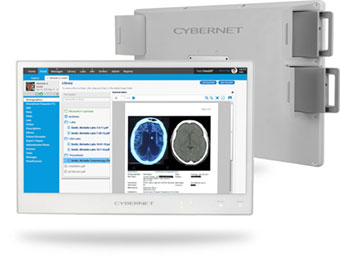
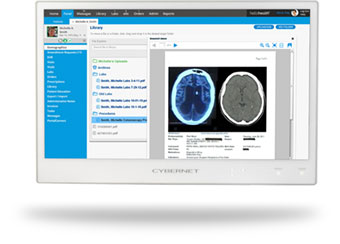
IT personnel configured the iOne for maximum efficiency within the exam room setting. Upon start-up, a user logs onto the hospital’s Citrix site. Citrix is a Web interface that gives authorized personnel access to Web applications available on a server. From this site, users can view, transfer or retrieve medical records with relative ease. Inputting and outputting of data is accomplished entirely with a keyboard. Operating the system requires no special software, other than Citrix and certain Web applications.
During initial installation, the iOne was put to work in a number of exam rooms. Placed on either counters or carts, the unit quickly proved itself more than capable in its new role. With the continued success of the iOne virtually assured, B.J. said it’s entirely possible that some day soon the Cybernet system will find its way into nursing stations. The presence of this sleek space saver will no doubt help to ease the overcrowded conditions so common in these areas.
How has the iOne performed since arriving at the hospital? According to B.J., “Great!” Currently, the hospital has 25 in operation. Since their arrival, the Cybernet systems have never required servicing or repairs. Such high reliability definitely has had a major impact on overall IT productivity.
The iOne most certainly has helped B.J.’s IT staff achieve their goal of providing unmatched service to doctors and nurses. Additionally, of course, it has had a favorable impact on the people they serve — the patients. Both doctors and nurses at the hospital echo the IT department’s approval rating, offering abundant praise for the iOne’s performance. For this hard-working medical staff, the reliability of the Cybernet model is a welcome relief from the unit’s unpredictable predecessor.
Impeccably reliable, the iOne has yet to miss a day of service at the Southern Illinois University School of Medicine. Despite the demands placed on the system, it provides access to critical medical data day and night.
Clearly, this high performance computer is in perfect health!